
How to Choose a MIDI Guitar Controller for Your Playing Style
How to Choose a MIDI Guitar Controller starts with a practical question: what do you want the instrument to accomplish when it is in your hands? A guitarist preparing for a live performance may need fast access to patches, reliable triggers, and expressive controls. A producer working in a studio may care more about programmable zones, software integration, and the ability to record detailed MIDI performances. A musician exploring two-handed tapping may want a compact instrument with a comfortable fingerboard layout.
A MIDI guitar controller is not simply a substitute for a standard guitar. It is a performance interface designed to send MIDI information to compatible synthesizers, samplers, sound modules, software instruments, and digital audio workstations. The correct choice depends on your technique, your preferred setup, the level of customization you need, and whether you plan to perform on stage, record in a studio, compose at home, or use the instrument in an educational environment.
Starr Labs offers several MIDI guitar controller options for different types of musicians. This guide explains the most important questions to ask before selecting a model.
How to Choose a MIDI Guitar Controller Based on Your Main Goal
The first step is identifying the role the controller will play in your music. A buyer who wants a portable instrument for straightforward MIDI control has different needs from a performer building a complex multi-layered live setup.
Choose a MIDI Guitar Controller for Live Performance
Live performers should focus on usability under real-world conditions. During a show, the best controller is the one that makes essential functions accessible without interrupting the performance. Consider whether you need fast patch changes, octave controls, expressive sensors, string triggers, tapping modes, wireless connectivity, or programmable zones for controlling multiple sounds.
A configurable model such as the Ztar Z6S MIDI guitar controller can suit musicians who want to strum touch-sensitive triggers, tap a touch-sensitive fingerboard, and assign different areas of the instrument to separate sounds. Players interested in advanced live setups can also review the Z7S Pro.
Musicians who want to see how other artists approach electronic instruments and performance technology can explore the featured artists page.
Choose a MIDI Guitar Controller for Studio Recording
Studio musicians should consider how quickly the controller can move from an idea to a recorded MIDI performance. A MIDI guitar controller can be used to play virtual instruments, sequence parts, experiment with alternate tunings, trigger samples, and record editable MIDI data inside a compatible digital audio workstation.
A programmable fretboard can help a producer move beyond conventional guitar voicings. Depending on the model and configuration, musicians may be able to divide the fingerboard into zones, assign different sounds to separate areas, and build a customized layout around the requirements of a recording session.
For a broader explanation of digital performance possibilities, read the existing MIDI guitar synth guide.
Choose a MIDI Guitar Controller for Two-Handed Tapping
Not every player wants to strum or pick. Musicians who specialize in tapping should examine the fingerboard layout, instrument size, playing position, and available tuning options.
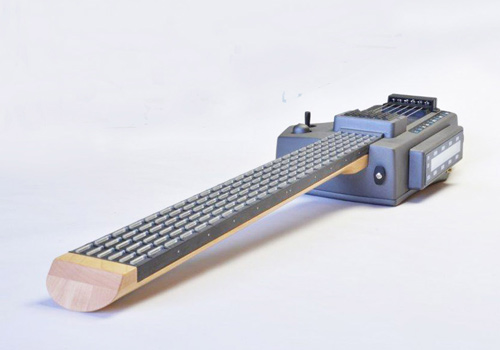
The MiniZ is designed around a compact playing position for two-handed tapping. Its format can be useful for musicians who want both hands to access the fingerboard comfortably while sitting or standing. Players seeking a different balance of size, features, and portability can also review the BabyZ.
How to Choose a MIDI Guitar Controller by Playing Technique
Your preferred technique should influence the model you select. Some musicians want a familiar guitar-oriented experience. Others want to treat the fingerboard as a programmable keyboard. Many players want the flexibility to use both approaches.
Strumming and Picking
If your technique depends on strumming or picking, look for a model with responsive triggers and controls that match the way you naturally perform. String-trigger options can provide a more guitar-oriented workflow while still sending MIDI information to connected devices.
The Z6 Series offers options for musicians who want a traditional guitar-style body with electronic control capabilities. Players can review the available configurations and choose the details that match their intended performance setup.
Keyboard-Style Tapping
If you prefer direct tapping, prioritize fingerboard response, comfortable access, and the ability to play notes without relying on a traditional guitar pickup. A tapping-focused setup can help musicians explore chord shapes, layered parts, and performance techniques that are difficult to reproduce on a conventional guitar.
A Combination of Tapping and Strumming
Some players need both methods. A hybrid workflow can be especially useful when one song calls for direct tapping and another requires a more guitar-like feel.
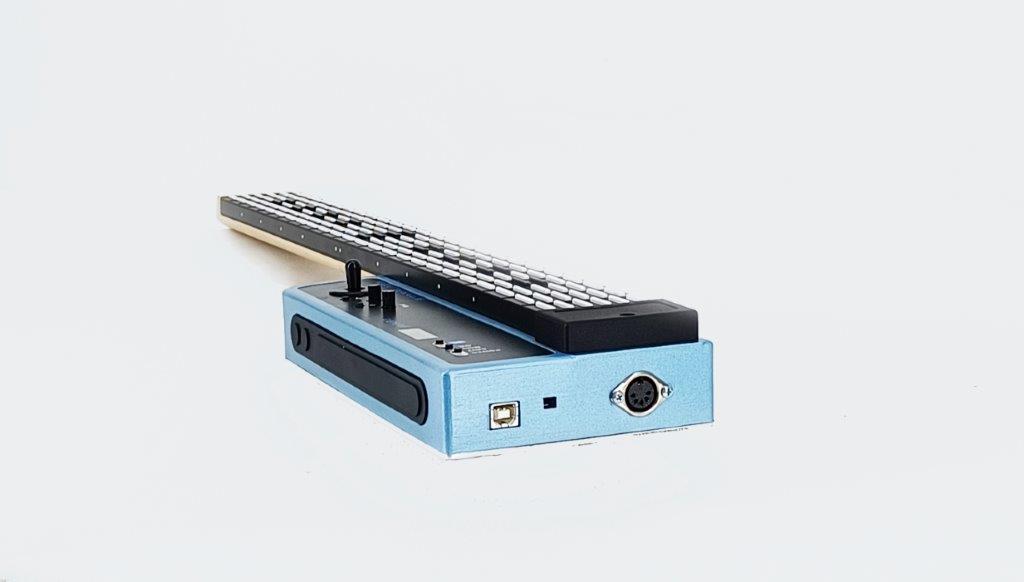
The portable GoTar-3 supports tapping and strumming-style performance in a streamlined format. Its compact design, velocity-sensitive key matrix, onboard controls, rechargeable battery, and MIDI connectivity make it an option for musicians who want an accessible controller for performance, production, or mobile use.
For a detailed introduction, review the existing GoTar-3 USB MIDI controller guide.
How to Choose a MIDI Guitar Controller With the Right Level of Customization
The best controller is not necessarily the model with the longest list of features. It is the model that provides enough control for your workflow without creating unnecessary complexity.
| Your Priority | What to Look For | Relevant Starr Labs Options |
|---|---|---|
| Portable and streamlined control | Compact design, core performance controls, convenient connectivity | GoTar-3 and BabyZ |
| Two-handed tapping | Comfortable fingerboard access and tapping-oriented layout | MiniZ |
| Advanced guitar-style performance | Responsive triggers, programmable zones, stored setups, expressive controls | Z6 Series, Z6S and Z7S |
| Bass-oriented MIDI control | Bass-focused fingerboard and performance controls | ZBass |
| Mobile iOS workflow | Bluetooth MIDI and mobile-device integration | iTar |
When a Streamlined MIDI Guitar Controller Makes Sense
A streamlined controller can be the correct decision when portability and speed matter more than extensive programming. A musician may want to connect quickly, load a virtual instrument, and begin performing without building a complicated custom map.
The GoTar-3 is designed around a focused set of features in a portable format. The BabyZ is another compact option for guitarists entering MIDI performance. Review the current in-stock instruments to see which products are ready for purchase.
When an Advanced Ztar Configuration Makes Sense
An advanced Ztar configuration is appropriate when the controller needs to operate as a central part of a larger performance system. Some musicians need programmable zones, alternate tunings, multiple sound layers, sensitivity adjustments, expression controls, wireless options, or customized sensor layouts.
Explore the Ztar MIDI guitar overview, read the Ztar MIDI guitar controller guide, or review the available Ztar MIDI guitar options before deciding which configuration fits your workflow.
How to Choose a MIDI Guitar Controller for Connectivity
Before ordering a controller, decide how it will connect to your existing equipment. Your workflow may involve a computer, a digital audio workstation, a hardware synthesizer, a software instrument, a mobile device, or a combination of several systems.
USB MIDI for Computer-Based Recording
USB connectivity is useful for musicians who plan to record into a computer, control virtual instruments, or integrate a controller with a digital audio workstation. A computer-based workflow can make it easier to edit MIDI notes after recording and experiment with a broad range of software sounds.
Traditional MIDI for Hardware Synthesizers
Musicians using hardware synthesizers, sound modules, or other external equipment should review the available MIDI connections and the requirements of their current setup. The ideal controller should fit into the signal path without adding unnecessary complications.
Wireless MIDI for Stage Mobility
Wireless MIDI can be useful when freedom of movement matters. A performer who does not want to remain tied to one position on stage should review model-specific wireless options and battery requirements before ordering.
Musicians interested in wireless accessories can review the CME WIDI Master BLE MIDI wireless product, or on-board BLE-MIDI options.
Bluetooth MIDI for Mobile Musicians
Mobile musicians should consider whether Bluetooth MIDI and mobile-device compatibility are important. Players building an iOS-centered setup can learn more about the iTar interactive MIDI guitar controller.
How to Choose a MIDI Guitar Controller for Your Instrument Range
Different players approach MIDI performance from different musical backgrounds. A guitar-style controller may be the natural fit for one musician, while another player may need an instrument designed around bass performance or an alternative layout.
MIDI Guitar Controllers for Guitarists
Guitarists should consider fingerboard response, trigger design, body shape, the learning curve, and the degree of programming available. The Starr Labs MIDI gear page provides an overview of available controller types.
MIDI Bass Controllers for Bass Players
Bass players seeking a dedicated MIDI instrument can review the ZBass. It is designed around bass-oriented MIDI performance rather than treating bass players as an afterthought in a guitar-centered setup.
Custom MIDI Controllers for Specialized Projects
Some performers need a controller that supports an unconventional workflow, installation, production environment, or performance concept. Learn more about the broader possibilities in the custom MIDI controller guide.
How to Choose a MIDI Guitar Controller Without Overbuying or Undershooting
A careful buying decision should account for both current needs and future growth. Choosing a controller with too few capabilities may limit your workflow later. Choosing an advanced configuration without a clear purpose may add features that you do not need.
Questions to Ask Before Ordering
- Will the controller be used primarily for live performances, studio recording, composition, education, or mobile production?
- Do you prefer tapping, strumming, picking, or a combination of techniques?
- Will you connect through USB, traditional MIDI, Bluetooth MIDI, or a wireless system?
- Do you need a lightweight controller for travel?
- Do you want a compact entry point or an advanced configurable instrument?
- Will you control one sound at a time or build layered multi-instrument performances?
- Do you need programmable zones, alternate tunings, expression controls, or custom mappings?
- Are left-handed controls or model-specific options important?
- Do you need an in-stock instrument or are you considering a custom-built configuration?
Review the MIDI controller questions page for additional guidance. You can also compare current options through the Starr Labs price list, browse the online shop, or check the latest sale products.
How to Choose a MIDI Guitar Controller: Frequently Asked Questions
What is a MIDI guitar controller?
A MIDI guitar controller is an electronic performance instrument that sends MIDI information to compatible software or hardware. It can be used to control synthesizers, virtual instruments, samplers, sound modules, and digital audio workstations.
Does a MIDI guitar controller produce sound on its own?
A MIDI guitar controller generally controls another device or software instrument that generates sound. Before ordering, confirm which computer, synthesizer, sound module, mobile device, or software instrument will be part of your setup.
Can a MIDI guitar controller work with a DAW?
Yes. A MIDI guitar controller can be used with a compatible digital audio workstation when it is connected and configured as a MIDI input device. This can allow a musician to perform software instruments and record editable MIDI information.
Should a beginner choose the controller with the most features?
Not necessarily. Beginners should choose a controller that supports their real goals. A portable and streamlined instrument may be more useful than an extensively customized model when the immediate objective is to learn MIDI performance and begin recording or playing live.
Which MIDI guitar controller is best for two-handed tapping?
The answer depends on the musician’s preferred size, layout, and required features. Players focused on two-handed tapping should review the MiniZ and compare it with other Starr Labs options before ordering.
Which MIDI guitar controller is best for advanced live performance?
Advanced performers should review models that support the specific controls they need, such as triggers, zones, tunings, presets, expression controls, and wireless options. The Z6 Series and Z7S are appropriate starting points for comparison.
Are compact MIDI guitar controllers available?
Yes. Starr Labs offers compact options for musicians who value portability. Review the GoTar-3, BabyZ, and MiniZ to compare their different designs and intended uses.
Can bass players use a dedicated MIDI controller?
Yes. Bass players can review the ZBass, which is designed specifically for bass-oriented MIDI performance.
Where can I get help selecting a MIDI guitar controller?
Visit the Starr Labs support page or use the contact page to describe your playing style, equipment, and performance goals.
Get Help Choosing the Right MIDI Guitar Controller
How to Choose a MIDI Guitar Controller becomes easier when you match the instrument to your actual workflow. The right model should support the way you play, connect with the equipment you already use, and provide enough room for your music to grow.
Call Starr Labs at 858-285-0831 for help comparing MIDI guitar controller options. You can also send a message through the Starr Labs contact page, review the latest in-stock instruments, or sign up for product news, specials, and upgrade information.